Dancing Lions Juggling Fish – by Phillip Nangle – 2020 – acrylic & oil on wood – 150 x 80 cm
I met a woman, beautiful, a dark woman, living below the slopes of the bowl of Table Mountain a long time ago before the Castle and all the white houses when thick forest ran down the mountain to fields beside the beach and we watched dancing lions juggling fish caught at the oceans edge from streams fed by copious springs.
Shumba Huru (the Big Lion) A traditional Zimbabwean piece of mbira music arranged and performed by Phillip Nangle on Njari, Karimba and traditional Southern African bowed instruments.
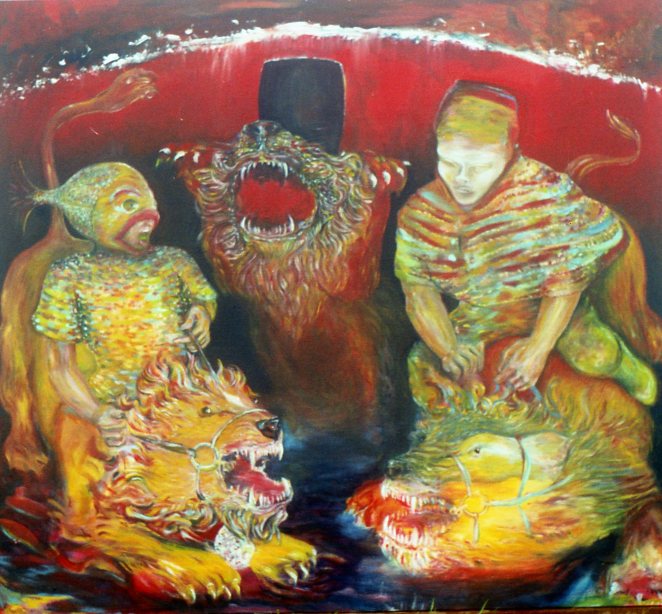
Painting: “Lion Riders” by Phillip Nangle. Oil on wood. 1.5 x 1.5 m. 2001
This is the most recent Njari that I have built. Below is a diagram of the note layout that I have developed and become accustomed to playing.
In this 39 reed instrument that spans 3 octaves and a third I have managed to keep the traditional pair of mid and high 4’s for each thumb as well as include a mid 3 on the right lower rank which is bent up (as in Matepe) to gain the access of the left thumb too if it happens to be around in that area at the required moment. Before I build an Njari for somebody I ask for the measurement of the distance between the tip of their left thumb and left middle finger. This measurement determines the width of the soundboard they will get.
Typically in Njari the 4 outer left reeds are plucked from below with the forefinger while the thumb can be playing the same notes an octave higher or lower. The mid range 1,2,3 (on left) can also be plucked from below with the forefinger while the thumb can choose between the lower octave 1,2,3 or a variety of octaves of 4,5,6. I use spring steel and brass for the reeds and in the lower octave each reed has three tuned notes:- the fundament, the 1st overtone 2 octaves and a third higher and the 2nd overtone an octave and a third above the 1st overtone. Therefore the deepest note 1 is comprised of a chord 1-3-5, the 2nd note a chord 2-4-6 and so on up.
For me the greatest challenges in building any mbira are in settling the bridge into the wood evenly for optimum sound transmission into the soundboard and in tying the bar onto the headstock perfectly so that the reeds are held with the correct pressure. Not too tight that they struggle to get in and not too loose that they need to be constantly bent to attain adequate tension. I choose to tie the bar onto the board traditionally rather than use nuts and bolts.
Segaba also known as segankore is the national instrument of Botswana. It is a traditional overtone violin with a short bow. By varying the tension of the bow with the thumb it can produce a very large pitch range. The string is usually stopped from below or the side in two or three positions and really good players are known to make the instrument speak. Traditionally it is used to accompany song and topical commentary.
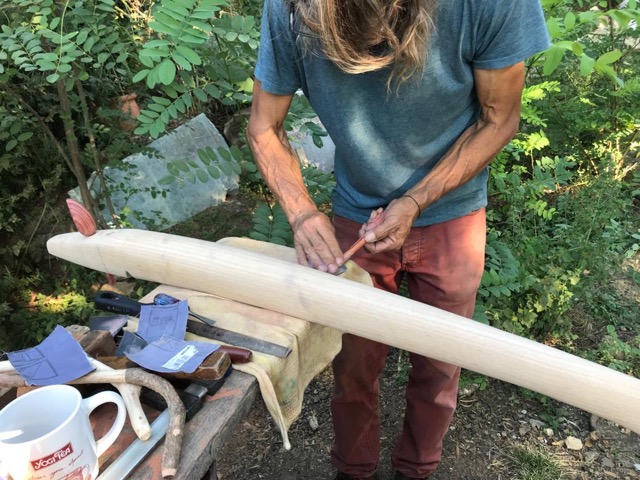
Traditional Botswana violin in progress. Chestnut body with Rose wood pegs. I use a Cello peg reamer for a perfect fit.
Bass Segaba using an Mbira deze as the resonator. The oldest Segaba I have seen has the resonator built up out of cow-dung. The contemporary resonator is a 5 litre oil drum scrunched tight onto the wooden body.
My two string soprano Segaba with a wooden resonator. For the bow I use the hairs from the tail of a wildebeest.





 Phillip Nangle